
From The Journal of America’s Military Past
By David Price
David Price has authored a trilogy about the “Ten Crucial Days” of the American War of Independence—Winning the Ten Crucial Days, The Road to Assunpink Creek, and Rescuing the Revolution—as well as John Haslet’s World and The Battle of Harlem Heights, 1776. The latter is part of the Westholme Small Battle series and was accepted into the permanent collection of the Connecticut Museum of Culture and History. David has been awarded the National Society of the Sons of the American Revolution Bronze Good Citizenship Medal and Certificate of Appreciation in recognition of his work as an author, speaker, and historical interpreter at Washington Crossing Historic Park (PA) and Princeton Battlefield State Park (NJ). He has written extensively for the prestigious, peer-reviewed Journal of the American Revolution, and this is his second article for JAMP. More information about David and his work can be found at dpauthor.com.
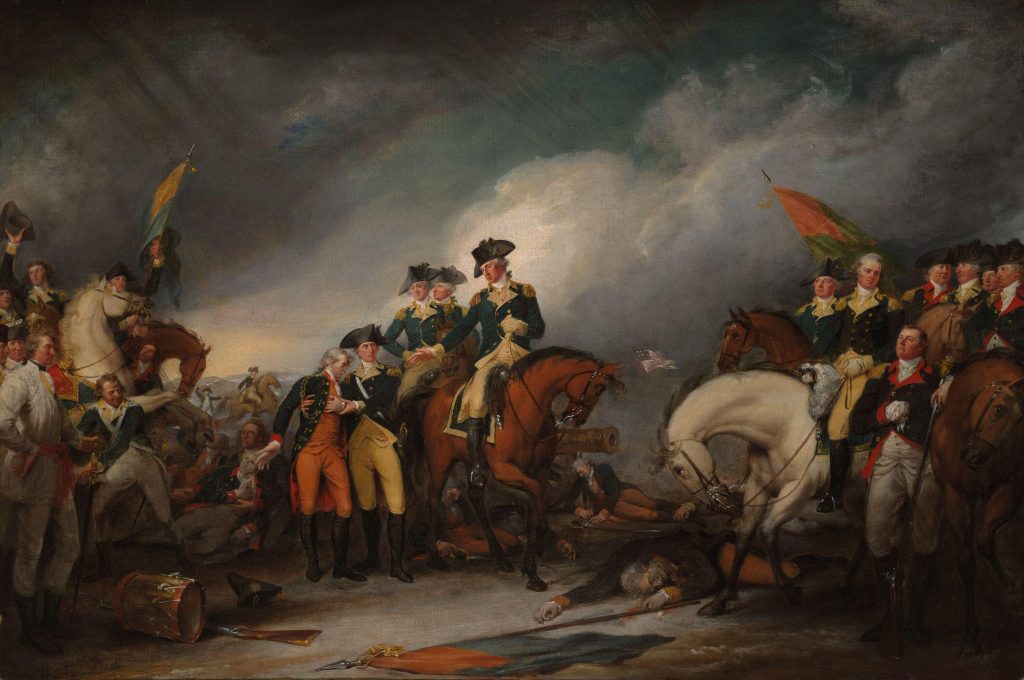
The “Ten Crucial Days” of the Revolutionary War, from 25 December 1776 through 3 January 1777, when George Washington’s army won its first three significant victories and reversed the momentum of the conflict, began with its legendary Christmas night 1776 crossing of the Delaware River. The English historian Sir George Otto Trevelyan famously wrote, “It may be doubted whether so small a number of men ever employed so short a period of time with greater and more lasting effects upon the history of the world.” Lord George Germain, Britain’s secretary of state for North America and principal war strategist, may have best and most succinctly articulated the significance of this event in his remarks to parliament in May 1779: “all our hopes were blasted by that unhappy affair at Trenton.”
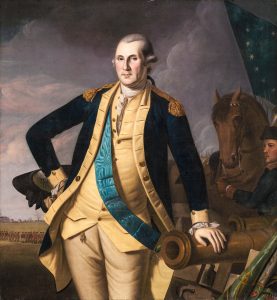
There appears to be a consensus that the 1776-1777 winter campaign was an unalloyed triumph for America’s most famous general. John Hancock, then president of Congress, praised his “wisdom and conduct [to which] the United States are indebted for the late success of their arms,” and the celebrated painter John Trumbull, at one point an aide-de-camp to Washington, later waxed hagiographic on the subject: “Thus, in the short space of nine days, an extensive country, an entire state, was wrested from the hands of a victorious enemy – superior in numbers, in arms, and in discipline – by the wisdom, activity, and energy of one great mind.” More recently, the ten-day campaign has been described by Revolutionary War historian John Ferling as Washington’s moment of true greatness. And the noted military historian, Don Higginbotham, asserted that these actions were perhaps Washington’s “only really brilliant stroke of the war.”
It is, though, arguable that the latter assessment is less than fair to the Continental Army’s commander-in-chief, for while perhaps not a brilliant strategist and allowing for the fact that he exhibited a litany of tactical flaws conducing to multiple defeats in the early stages of the contest (at Long Island, Kip’s Bay, Fort Washington, Brandywine Creek, and Germantown), Washington did have his moments of conspicuous resolve that bred success throughout the struggle, aside from carrying the day at Trenton and Princeton. In the opinion of this observer, the following examples are most worthy of recognition. They are listed chronologically and not according to any ranking of their importance. (Let the argument about that begin.)
Procuring Cannon during the Siege of Boston
“Brilliant” may not be the operative adjective for Washington’s orders of 16 November 1775 to Col. Henry Knox to retrieve a supply of cannon from Fort Ticonderoga, on the southern edge of Lake Champlain in upper New York State, which – when placed on Dorchester Heights outside British-occupied Boston – compelled the Crown’s troops to evacuate in March 1776. It would, however, appear to be a shrewd piece of generalship, notwithstanding that Lt. Gen. William Howe, the British commander there, had been planning to leave Boston for months anyway and that Washington’s generals had to dissuade him from launching imprudent attacks against the occupying force before the cannon arrived.
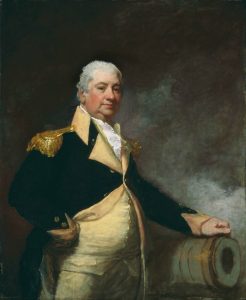 Washington deserves ample credit for approving this effort to supply his army with the weaponry it desperately needed and for discerning in the twenty-five-year-old Knox – who created the Continentals’ artillery wing and would become a brigadier, and ultimately major, general – the ability to carry out such a complicated and dangerous mission in the dead of winter over an extended and challenging terrain that included rolling hills, winding rivers, lakes, and seldom-used roads. By endorsing Knox’s proposal to fetch the cannon, the commander in chief overruled the objections of some in his circle who believed this would be an exercise in futility.
The possibilities, intricacies, and leverage of artillery appealed to Knox’s curiosity and foresight. In peacetime, he had pored over textbooks on military science in a Boston bookshop where he clerked prior to opening the London Bookstore in 1771, as well as scouring volumes from the Harvard library. He created the army’s artillery wing from scratch by securing nearly sixty cannon from Fort Ticonderoga and transporting them three hundred miles in a forty-day journey, through the Berkshire Mountains, to Washington, who anxiously awaited their delivery in Cambridge on the edge of Boston. Before this, the rebels had only one artillery regiment with about a dozen cannon; after all, the colonies had always counted on Britain to supply them with such guns in wartime. In carrying out one of the most remarkable undertakings of the war, Knox fulfilled his mission to collect as many cannon and as much ammunition as he could move, for as Washington had emphasized, “the want of them is so great that no trouble or expense must be spared to obtain them.” Knox himself spoke of that urgency during his venture, confirming in a letter to Washington from Albany, New York, on 5 January 1776 that “my mind is fully sensible of the greatest expedition in this case” and pledging his “utmost endeavors” to forward his precious cargo “with the utmost dispatch.”
The expedition to Ticonderoga yielded thirty-nine field pieces, two howitzers, and fourteen mortars. Those guns were not only British but also included French pieces captured in the last war, which differed in length from those made in England and thus required different ammunition – just one of many technical challenges Knox would have to manage. Washington now had the means to liberate Boston from British occupation and enjoy the Continentals’ first taste of victory. In the midst of Knox’s exertions, Congress in late 1775 commissioned him “Colonel of the Regiment of Artillery” in response to the commander in chief’s recommendation. Without benefit of formal military training, Knox tutored himself in strategy, tactics, and gunnery, and became a skillful and innovative artillery commander. That fact did not escape Washington, who assured his artillery maestro, when writing from Cambridge shortly after Howe’s withdrawal, “Trusting in your zeal, diligence, and ability, I remain confident of every exertion in your power for the public service.” Perhaps the general’s appreciation was heightened by the fact that his prior soldiering included no experience directing cannon.
In fashioning the insurgents’ artillery arm, Knox was largely responsible for one of the most impressive developments in the story of Washington’s army. For this reason, he has been described as one of those providential individuals who arise in an emergency as though they were formed by and for the occasion. Indeed, a biographer of his insists that if Washington was the indispensable man of the Revolution, then Knox was his indispensable man, for he played an important role in every one of Washington’s victories. Accordingly, Washington’s decision to send Knox for the cannon at Fort Ticonderoga was vitally important for reasons that extended far beyond its impact on the siege of Boston. The faith the middle-aged Virginian put in the young Bostonian at that time marked the beginning of a working relationship between the two that would have enormous implications for the functioning of the Continental Army throughout the contest.
Saving Half His Army at Long Island
The evacuation of American troops from Brooklyn Heights to Manhattan Island on the night of 29-30 August 1776 was one of the most skillful in military history. Of course, one might contend that it merely compensated for the general’s litany of errors in connection with the battle of Long Island on 27 August; still it saved half his army (the other half being on Manhattan Island) from complete destruction as its situation was indeed dire following that engagement.
On 28 August, Joseph Hodgkins, in a letter to his wife, reported, “The enemy are within a mile and a half of our lines.” The next day, the army’s adjutant general, Col. Joseph Reed, wrote his wife that the enemy were “intrenching at a small distance” and that “our situation is truly critical.” At that point, the British officer Charles Stedman recalled, the American army “had been driven to the corner of an island, where they were hemmed in within the narrow space of two square miles” and “lay almost entirely at the will of the English.” And Gen. John Morin Scott described the circumstances facing the rebel forces inside their Brooklyn defenses, with their backs to the East River: “Invested by an enemy of about double our number from water to water, scant in almost every necessary of life and without covering and liable every moment to have the communication between us and the city cut off by the entrance of the frigates into the East River.”
That moment was nothing if not pivotal. Although Washington could be slow to action and indecisive at times, he made a rapid decision to extricate his troops from their impending peril when it was most needed, acting boldly and at great risk. By the time he called a council of war on the afternoon of 29 August at the Philip Livingston mansion near the river to discuss the question of whether to withdraw from Brooklyn, the commander in chief had already begun to collect the boats; and he ordered that the evacuation begin immediately. The crossing began at eight that evening.
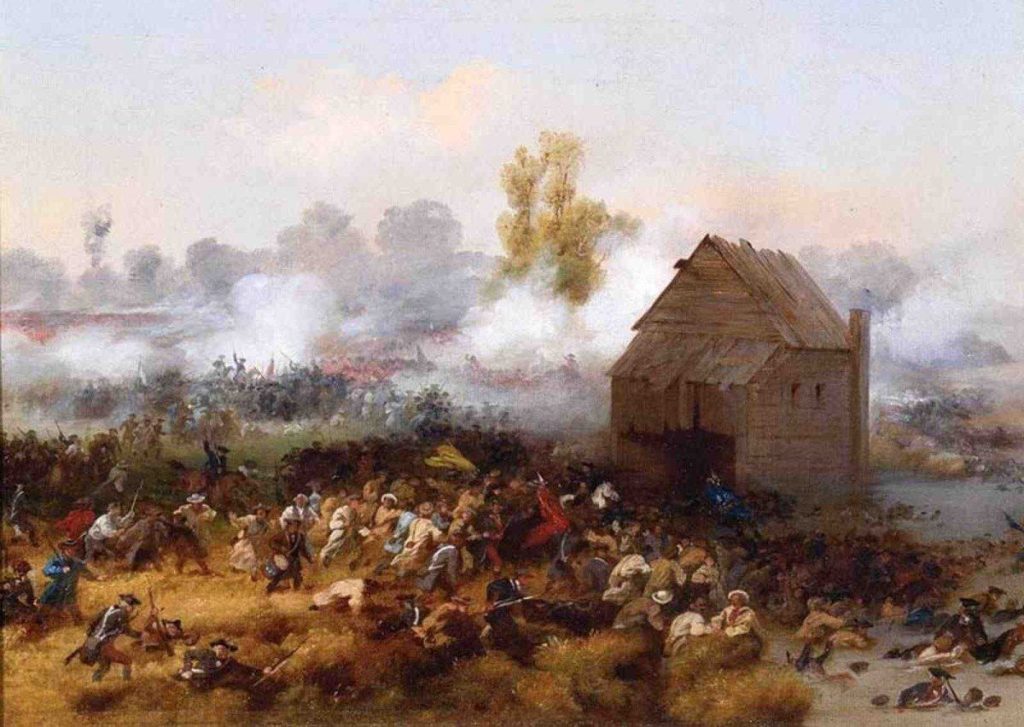
This nautical enterprise was facilitated by high winds that prevented British warships from moving up the river just prior to and during the battle, and a storm that hovered for two days afterwards. Darkness, accompanied by a thick fog at dawn, concealed the removal of virtually the entire American force and most of its stores across the river, near where the Brooklyn Bridge is today. By seven a.m. on the 30th, small craft had carried 9,500 soldiers, their horses, and most of their equipment over to Manhattan. Washington, who salvaged all but five of his cannon, left with the last of the troops. Gen. Howe’s deputy adjutant general, Stephen Kemble, noted the rebels’ escape in his journal for that day: “In the morning, to our great astonishment, found they had evacuated all their works on Brooklyn and Red Hook, without a shot fired at them.”
To be sure, Long Island was lost, but Washington had preserved his army by a deft maneuver that arguably made amends for the faulty judgment he evinced prior to the battle. This operation, performed at night in small boats on a difficult waterway and eluding a numerically larger enemy and its imposing fleet, qualifies as one of the most skillful evacuations in the chronicles of armed conflict. According to one historian, it was “well-timed and happily effected.” It has been described by another as flawless and “one of the greatest moments in the annals of warfare,” given its impact. And to another, it stands as “one of the most brilliant tactical withdrawals” in military history and “a quite miraculous extraction that defied all the conventional tactics of modern warfare.”
In the aftermath of what he termed “the retreat from Long Island,” Washington sought to bolster the army’s faltering morale by informing “both officers and soldiers” that the decision to fall back on Manhattan reflected “the unanimous advice” of his generals, and did not arise “from any doubts of the spirits of the troops,” but because they were “very much fatigued with hard duty and divided into many detachments, while the enemy had their main body on the island, and [were] capable of receiving assistance” from the Royal Navy. Lt. Benjamin Tallmadge, then twenty-two-years-old and a friend of the Patriot hero Nathan Hale, recalled the formidable obstacles Washington faced in trying to transport “so large a body of troops, with all their necessary appendages, across a river full a mile wide, with a rapid current, in face of a victorious, well-disciplined army, nearly three times as numerous as his own, and a fleet capable of stopping the navigation, so that not one boat could have passed over.” He did not “recollect a more fortunate retreat” in “the history of warfare” and opined that “Gen. Washington has never received the credit which was due to him for this wise and most fortunate measure.”
Ordering Smallpox Inoculation for the Continental Army
Perhaps Washington’s most judicious stroke of the war, albeit not of a strictly military nature, was to order mass inoculation of the army against smallpox in early 1777. It could be argued that he had no choice, but it was still a dramatic gesture that was not without controversy and probably indispensable to preserving the integrity of his army. This scourge, caused by the variola virus and highly contagious, was the most deforming and lethal of the plague-like outbreaks in the seventeenth and eighteenth centuries, accompanied as it was by frightful pitting of the skin, loss of eyebrows and lashes, severe scarring, and even blindness. It was rampant in the colonies as well as Europe, having reached epidemic proportions during the first two years of the war and decimated the American force that invaded Canada in 1775.
By the early eighteenth century, inoculation was known to confer a lifetime immunity on those who underwent it, although the practice was still viewed with suspicion. This type of immunization, by which a small amount of pus from a recuperating victim was introduced through a cut in the skin and followed by a number of days in quarantine, had been an accepted practice in the British army for some time, and Gen. Howe in 1775 ordered his unvaccinated soldiers in Boston to submit to the procedure. It had been available for decades, and prominent colonists such as Benjamin Franklin, Thomas Jefferson, and John Adams availed themselves of it. Having endured smallpox as a young man, the Continental Army’s commander in chief was immune. It is likely that Washington overcame his initial reluctance to order inoculation, thinking it too risky, because a fear of contracting this malady in army camps was impeding the recruiting effort.
In February 1777, the general directed that every soldier in the army who had not already had smallpox be inoculated against the disease. In his instructions to Dr. William Shippen, Jr., Director General of the Continental Army’s hospitals from 1777 to 1781, he wrote, “Finding the smallpox to be spreading much and fearing that no precaution can prevent it from running through the whole of our army, I have determined that the troops shall be inoculated. This expedient may be attended with some inconveniences and some disadvantages, but yet I trust in its consequences will have the most happy effects.” As Washington saw it, there was no alternative: “Necessity not only authorizes but seems to require the measure, for should the disorder infect the army in the natural way and rage with its usual virulence, we should have more to dread from it than from the sword of the enemy.” He charged Shippen to, “without delay, inoculate all the Continental troops that are in Philadelphia and those that shall come in as fast as they arrive,” and to “spare no pains to carry them through the disorder with the utmost expedition, and to have them cleansed from the infection when recovered.” Washington expressed his hope “that in a short space of time we shall have an army not subject to this the greatest of all calamities that can befall it when taken in the natural way.”
Mass inoculation was a stunning success that resulted in the Continental ranks being almost free of smallpox within a year. Some historians say this effort – the first major public health initiative undertaken in America – was Washington’s most unheralded contribution to the outcome of the rebellion. More than one modern-day chronicler has concluded that it saved his army from disintegration. And in the judgment of one medical writer, it was “a factor of considerable importance” in winning the war. One might say the quest for independence led to a revolutionary development in public health, no less than in the political status of the thirteen colonies.
Reinforcing Horatio Gates’s Army during the Saratoga Campaign
With few exceptions, historians judge the Saratoga campaign to be the most decisive military event of the war (except perhaps Yorktown). It culminated with the surrender of Maj. Gen. John Burgoyne’s outnumbered Anglo-German troops to the Northern Army under Maj. Gen. Horatio Gates at Saratoga on 17 October 1777. The rebel victory proved to be of monumental significance, propelling France into the contest as America’s crucial ally and turning the conflict into a global struggle.
Washington’s dispatch on 16 August 1777 of Col. Daniel Morgan’s riflemen – the most elite unit in the Continental Army – to reinforce the northern troops facing Burgoyne’s Anglo-German expedition considerably boosted the spirits of Gates’s soldiers and, most importantly, their combat effectiveness. They were among the finest light infantry of that time. Because of Morgan’s experience commanding light infantry in battle, Washington named him to lead the army’s newly formed rifle corps in June 1777; and their uniform – a distinctive off-white, fringed hunting shirt – helped them establish a unique identity.
 The colonel’s veteran unit consisted of several hundred Pennsylvania and Virginia sharpshooters, each of whom was proficient in the use of the deadly Pennsylvania long rifle. Its barrel was etched or “rifled” with seven or eight grooves, unlike smooth-bore muskets, making it highly accurate up to two hundred yards and capable of hitting targets at up to three hundred yards – several times that of a musket. Their value was recognized by Congress when it established the Continental Army in June 1775 in support of New England’s uprising against the British troops in Boston. Although rifles were popular in more rural areas of the colonies, they were largely unknown around Boston; and John Adams waxed enthusiastic when informing his wife Abigail of the congressional decision to make use of them: “The continent is really in earnest in defending the country. They have voted 10 companies of riflemen, to be sent from Pennsylvania, Maryland, and Virginia, to join the army before Boston. These are an excellent species of light infantry.” He described this firearm as “a peculiar kind of musket” that “carries a ball with great exactness to great distances” and gushed over these crack shots as “the most accurate marksmen in the world.”
Morgan’s corps, including his riflemen and five companies of New England light infantry under Maj. Henry Dearborn, would anchor the Northern Army’s left wing under Maj. Gen. Benedict Arnold. The New Englanders complemented Morgan’s sharpshooters in that they carried muskets equipped with bayonets, which rifles did not accommodate, and so could protect those using the latter in close-quarter action. At the battle of Freeman’s Farm on 19 September, Morgan’s men trained their precision fire on British officers and knocked many out of the fighting early, demoralizing their rank-and-file. According to one Continental officer, the colonel “astonished the English and Germans with the lethal fire of his rifles.” Burgoyne’s troops held the field at the end of that encounter, but a British officer, Lt. Thomas Anburey, expressed his concern that “the real advantages resulting from this hard-fought battle, will rest on that of the Americans, our army being so much weakened by this engagement, as not to be of sufficient strength to venture forth and improve the victory, which may, in the end, put a stop to our intended expedition.”
At the battle of Bemis Heights on 7 October, one of Morgan’s white shirts reportedly inflicted a fatal wound upon Brig. Gen. Simon Fraser, “the best officer under Burgoyne” and one esteemed by his fellow officers and the common soldiers in the imperial expedition, who was attempting to rally his men. Fellow Briton William Digby remarked that “when General Burgoyne saw him fall, he seemed then to feel in the highest degree our disagreeable situation.” Morgan later maintained that he had ordered one of his riflemen up a tree to take aim at a mounted British officer, whose identity is uncertain, but that the officer was struck – and it was around this time that Fraser suddenly doubled over in the saddle with a bullet in his left side. As Samuel Woodruff of Connecticut recalled, “General Fraser, mounted on a gray horse a little to the right of their center and greatly distinguishing himself by his activity, received a rifle shot through his body (supposed to be from one of Colonel Morgan’s sharpshooters), of which he died the next morning at eight o’clock.” Shortly after he was hit, “the British grenadiers began reluctantly to give ground, and their whole line, within a few minutes, appeared broken.”
Writing to Washington at this time, Gates referred to Morgan’s expert marksmen as “the corps the army of General Burgoyne are most afraid of.” If Washington’s dispatch of this contingent to support the resistance to Burgoyne was not brilliant, it certainly lays claim to being very astute. He fully embraced his responsibilities as commander in chief by sending vital help to the army’s Northern Department, even while facing the challenge of defending the American capital at Philadelphia against Howe’s superior force in the late summer of 1777.
Naming Baron Von Steuben Inspector General of the Army
The arrival at the storied Valley Forge encampment on 24 February 1778 of Friedrich Wilhelm von Steuben provided Washington with an opportunity to reform the army’s discipline and drill. A forty-eight-year-old former officer in the Prussian Army of Frederick the Great who had served in the military since age sixteen, he was the scion of a noble but not wealthy family. Hitherto, the army had been severely plagued by an incapacity for close-order drill, which impeded coordination among units attempting to maneuver under fire. Acknowledging the newcomer’s extensive military experience, especially in training troops, Washington designated him as the army’s acting inspector general. Von Steuben, who began his service with the Continentals as a volunteer, proved to be an outstanding drill inspector and a major factor in strengthening the army that finally emerged from its 1777-1778 winter quarters. That force was well organized and better disciplined as a result of implementing the baron’s training program.
Washington conveyed his need for, and assessment of, von Steuben to the president of Congress, Henry Laurens, on 30 April, explaining that the “extensive ill consequences arising from a want of uniformity in discipline and maneuvers throughout the army have long occasioned me to wish for the establishment of a well-organized inspectorship,” and that concurrence by the members of Congress on this point “has induced me to set on foot a temporary institution, which from the success that has hitherto attended it, gives me the most flattering expectations, and will I hope obtain their approbation.” The baron’s length of military service in Europe “pointed him out as a person peculiarly qualified to be at the head of [the inspector general] department,” and assigning him the duties of acting inspector general – drilling the men, overseeing their discipline, and assisting the commissaries that fed and clothed them – “appeared the least exceptionable way of introducing him into the army and one that would give him the most ready opportunity of displaying his talents. In Washington’s judgment, von Steuben had performed these duties “with a zeal and intelligence equal to our wishes,” accompanied by two ranks of inspectors under him, the lowest being charged with the inspection of brigades and the others superintending several of these brigade inspectors, each with “written instructions relative to their several functions,” and the maneuvers to be practiced being demonstrated “by a company which the baron has taken the pains to train himself.” The commander in chief further advised that “I should do injustice if I were to be longer silent with regard to [von Steuben’s] merits,” including “his knowledge of his profession added to the zeal which he has discovered since he began upon the functions of his office.” These considerations led Washington “to consider him as an acquisition to the service and to recommend him to the attention of Congress,” with the understanding that his rank would be that of a major general, as “his finances … will not admit of his serving without the incident emoluments,” and the expectation that “Congress, I presume from his character and their own knowledge of him, will without difficulty gratify him in these particulars.” Indeed, it did, formally appointing the Prussian as inspector general with the rank of major general on 5 May.
Von Steuben introduced a new attitude toward discipline and a new degree of economy into the army, which began almost immediately and continued to improve, even with setbacks, until the war ended. On 6 May, the army at Valley Forge celebrated the new alliance with France “with as much splendor as the short notice would allow,” including brigade maneuvers, artillery salutes, and running musket fire “which was executed to perfection,” in the description of Lt. Col. John Laurens, an aide-de-camp to Washington. Writing to his father Henry, the colonel reported that the event “was managed by signal, and the plan as formed by Baron de Steuben succeeded in every particular, which is in a great measure to be attributed to his unwearied attention and to the visible progress which the troops have already made under his discipline.”
An excerpt from the poetry of regimental surgeon Albigence Waldo of Connecticut, written late in the encampment, would appear to evince the fruit of von Steuben’s efforts to drill and train the army:
“The day serene – joy sparkles round
Camp, hills and dales with mirth resound,
All with clean clothes and powdered hair
For sport or duty now appear,
Here squads in martial exercise
There whole brigades in order rise,
With cautious steps they march and wheel.
Double – form ranks – platoons – at will
Columns on columns justly roll,
Advance, retreat, or form one whole.”
Waldo’s upbeat verse from the spring of 1778 reflects the improved spirits of the Continentals, who had endured a harrowing winter and were now prepared to renew the rigors of marches and combat as a more professional fighting force owing to the tutelage of the colorful baron. It was not long before the rebel troops had an opportunity to exhibit their newfound discipline and skill. On 28 June, shortly after breaking camp and heading east across New Jersey in pursuit of Maj. Gen. Henry Clinton’s army that was withdrawing from Philadelphia to New York for redeployment, the insurgent combatants held their own in a daylong clash at Monmouth Courthouse. The battle ended in a tactical draw that allowed Clinton to complete his return to New York but further fueled the enemy’s realization that the Patriot soldiery were a considerably more dangerous adversary than they had been before.
In March 1779, Congress would officially adopt the protocol set forth in von Steuben’s drill manual, Regulations for the Oder and Discipline of the Troops of the United States. At war’s end, Washington imparted to him “in the strongest terms my entire approbation of your conduct, and … my sense of the obligations the public is under to you, for your faithful and meritorious services.” It is said he purposely waited to write his last letter as commander in chief to the charismatic Prussian.
Sending Nathanael Greene South
Washington’s naming of Maj. Gen. Nathanael Greene to command the Southern Department of the Continental Army on 14 October 1780, which Congress approved after its earlier failure to appoint Greene to this position, was more than brilliant. It was genius, particularly as it followed on the heels of the disasters that had befallen a succession of other American generals in the South who preceded Greene: Robert Howe, Benjamin Lincoln, and Horatio Gates, the latter having been appointed by Congress ahead of Washington’s personal choice, Greene. The surrender of Charleston by Lincoln the previous May and Gates’s debacle at the battle of Camden that August had rendered prospects in the region dim indeed, but Greene’s masterful Southern campaign – in the face of seemingly insuperable challenges and with the vital assistance of rebel militia led by the likes of Brig. Gen. Thomas Sumter (“the Gamecock”), Col. Francis Marion (“the Swamp Fox”), and Brig. Gen. Andrew Pickens – would drive the British from the interior of the Carolinas and pin them inside their seaboard sanctuaries in Charleston and Savannah. These they evacuated before the end of 1782. By then, the Rhode Island Quaker-turned-Patriot warrior, who actively assumed command in the South on 3 December 1780, had compiled a record of achievement that has been described as breathtaking, for the British – who believed that Georgia and South Carolina were subjugated and pacified when the summer of 1780 ended – were now confined to those coastal enclaves.
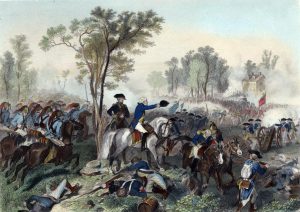 British Maj. Frederick Mackenzie remarked that Greene’s report to Congress on the brutal battle of Eutaw Springs, South Carolina, on 8 September 1781 “seems principally designed to gloss over a defeat by bestowing great praise on all the officers and troops under his command. Greene was, however, entitled to great praise for his wonderful exertions,” according to MacKenzie, for “the more he is beaten, the farther he advances in the end. He has been indefatigable in collecting troops and leading them to be defeated.” Of course, MacKenzie failed to realize, or at least to admit, that the technical reversals Greene suffered at places like Guilford Courthouse, Hobkirk Hill, and Eutaw Springs really served his purposes. These costly British wins represented a strategic mishap for England by depleting its precious reserves of military manpower and failing to neutralize American forces in the field or shift public opinion towards the Loyalist viewpoint.
In addition, Greene’s engagement with the army of Maj. Gen. Charles, Earl Cornwallis at Guilford Courthouse, North Carolina, on 15 March 1781, which reduced His Lordship’s already depleted army by twenty-five percent as the price of his pyrrhic victory, compelled the latter to retreat to Wilmington on the coast and persuaded him to abandon North Carolina. From there, Cornwallis relocated his force to Virginia, setting the stage for his ultimate defeat at Yorktown and signaling the end of any major British offensive operations in the Carolinas and Georgia. This freed Greene to move into South Carolina, where the combined exploits of his Continentals and militia led to the fall of one British outpost after another in the backcountry. When he memorably asserted his resolve to rebound from one of his purely tactical setbacks, at the battle of Hobkirk Hill on 25 April 1781, Greene arguably expressed the general strategy behind the rebel effort throughout the war. To the Chevalier de La Luzerne, the French minister to the United States, three days after that encounter, he declared, “We fight, get beat, rise, and fight again.”
While overseeing the siege of Yorktown, Washington acknowledged Greene’s claims of success at Eutaw Springs by congratulating him “upon a victory as splendid as I hope it will prove important.” John Adams, writing more than a month after Cornwallis’s surrender, opined that “General Greene’s last action in South Carolina … is quite as glorious for the American arms as the capture of Cornwallis.” Not to be outdone, Congress awarded the presumed victor a gold medal, one of six authorized by Congress for battles or campaigns of the Revolutionary War. Today, the bronze doors of the U.S. House of Representatives include as one of their six panels of history the presentation of the medal and a flag to Greene by the Continental Congress for the affair at Eutaw Springs. Brig. Gen. (soon to be Maj. Gen.) Henry Knox’s approbation of Greene’s efforts in the South perhaps rang the loudest, noting that he had “performed wonders” without “an army, without means, without anything.” Even before Eutaw Springs, Dr. Benjamin Rush, writing to Greene from Philadelphia, spoke of “the praise given to you and your little army for your exertions and suffering in the common cause,” while “the South Carolina refugees in this city drink your health every day with a pleasure that discovers that they view you as one of their deliverers from the tyranny of Britain.”
As one scholar puts it, Greene fought his war with skill and imagination. And another concludes that of all Washington’s officers, he was the only one with the skill, judgment, and character to withstand the challenges of the Southern campaign and emerge victorious, and that his predecessors in that theater would have folded under the pressure. A Greene biographer notes that the general lost or tied every major battle he fought but in doing so fulfilled his mission and preserved the Revolutionary cause in the South, proving himself a relentless, organized, and disciplined leader who recognized that as long as he fielded an army, he could not lose in the end.
Deceiving Henry Clinton about the Army’s March to Yorktown
One could reasonably characterize as “brilliant” the adroit maneuvers orchestrated by Washington in the late summer of 1781 to deceive General Clinton in British-occupied New York City into thinking that a Franco-American offensive against Manhattan Island was impending. This subterfuge diverted Clinton’s attention from the movement of allied forces southward to trap Cornwallis’s army at Yorktown and thereby precluded his timely intervention to foil the enemy’s plan. The well-orchestrated ruse conduced to what became the climactic American military victory of the war.
On 17 August, two days before his troops and the French army commanded by the Comte de Rochambeau commenced their headlong rush to reach Virginia in time to ensnare Cornwallis, Washington advised Admiral de Grasse – commanding the French fleet headed from St. Domingue to Chesapeake Bay – that “it has been judged expedient to give up for the present the enterprise against New York and to turn our attention towards the South, with a view, if we should not be able to attempt Charlestown itself, to recover and secure the states of Virginia, North Carolina, and the country of South Carolina and Georgia.” As such, he informed de Grasse that “we have determined to remove the whole of the French Army and as large a detachment of the American as can be spared to Chesapeake, to meet Your Excellency there.”
As his army hastened south, Washington went to great lengths to dupe Clinton into expecting an assault on his garrison. This included pitching a small city of tents on the west bank of the Hudson (then North) River and arranging for wagons to move conspicuously in and out of this fictional camp, as well having American boats ply nearby waters and lay down pontoons in imaginary preparation for an amphibious sortie. Meanwhile, the rebel troops, being deceived as to their true destination as much as the British, marched through New Jersey towards Trenton and joined up with their French counterparts at Princeton. Washington engineered a series of what one biographer terms “ingenious stratagems” to disguise the actual purpose of this exercise. He split his army into three parallel columns and brought them forward at staggered intervals, with the soldiers having no knowledge of where they were headed until they reached Trenton, where the artillery were loaded onto boats to carry those guns downriver to Delaware, as the American and French columns continued their march south.
 Not until 2 September, when Washington and Rochambeau were in Philadelphia with their armies soon to follow them into the city, did Clinton fully realize that they were not about to strike New York but were rapidly heading south. By then, it was too late for Sir Henry to impede his foe’s progress. “Thus by threatening us with a siege,” one of his officers, Frederick Mackenzie, wrote, “the enemy have been suffered to come within sight of our posts, to retire thence again, to pass the Hudson, and to advance a good way into Jersey, without molestation or obstruction; while the army in Virginia … is now entirely unprepared for being attacked by a fleet and an army.”
On 14 September, the rebel leader entered Williamsburg, Virginia, where he delighted in reuniting with the Marquis de Lafayette, whose army had been jousting with Cornwallis in the days leading up to the latter ensconcing his forces in Yorktown. In his general orders issued the next day, Washington, whose elaborate ploy had set the stage for trapping the enemy by the James River, eagerly anticipated the unfolding of the drama that would culminate in a triumph of paramount importance. He enthused over joining Lafayette’s army “with prospects which (under the smiles of heaven) he [Washington] doubts not will crown their toils with the most brilliant success.”
Perspective
Washington’s ultimate success was obviously notwithstanding a litany of challenges, including shortages of soldiers, shoes, blankets, equipment, food, and gunpowder; selfish, apathetic states; congressional bureaucratic ineptitude; and an adversary featuring the most able professional military minds Britain could employ in this contest. In the aggregate, they posed a formidable obstacle to what the Virginian termed the “glorious cause” of American independence. As he opined in addressing his troops on 18 April 1783, in observance of “the cessation of hostilities between the United States of America and the King of Great Britain,” that cause ultimately prevailed over a militarily superior opponent in a war of attrition, “firmly secured by the smiles of heaven on the purity of our cause” with their victory achieved by “the honest exertions of a feeble people (determined to be free) against a [powerful] nation (disposed to oppress them) and the character of those who have persevered through every extremity of hardship, suffering, and danger being immortalized by the illustrious appellation of the Patriot army.” The army’s commander in chief omitted any reference to the unforced errors made by him and other revolutionary generals along the way, but these, of course, would matter far less than the final result, as Henry Knox told Washington in April 1778: “Success in military matters procures applause and covers every defect in planning or executing an enterprise.”
The record of Washington’s generalship was, to be sure, a mixed bag, and the intent of this narrative is not to weigh his wins against his losses. It is solely to give credit where credit is due, and especially to someone who, objectively, was not equipped by military experience to lead a continental fighting force when he assumed command of the army in 1775. He was not familiar with artillery or cavalry, had never led a large army in open-field combat, and had less professional military experience than Charles Lee or Horatio Gates, the veteran British officers who had signed onto the Patriot cause. The congressional delegates seemingly accorded first priority to political considerations in selecting an individual to lead their army whom they knew and trusted less as a soldier than as a legislator (from his time as a member of the Virginia House of Burgesses and Congress itself), albeit one who knew more about military matters then they did. Then too, John Adams, in nominating Washington to lead the army, recognized that Virginia was the largest colony, and his fellow New Englanders eagerly sought the support of their Southern brethren for the rebellion.
The question of whether Washington was indispensable to the Patriot quest may be debated among historians forever, but it would appear that one thing can be said with certainty: if he was not, nobody was. And the belief among many at the time that his leadership was essential to winning the war loomed large in his public persona and the confidence of those soldiers and civilians who followed him. Caesar Rodney, Delaware’s most prominent Revolutionary figure and a signer of the Declaration of Independence, undoubtedly spoke for many when – following the rebel triumph at Princeton in January 1777 – he wrote: “While Washington survives, the great American cause cannot die.” As one of his biographers notes, the Continentals’ foremost commander was not in the class of a military prodigy or genius renowned for an unrelenting series of victories (think Alexander the Great or Julius Caesar); however, to be successful, he did not have to be the best general there was. He only had to be better than the generals he faced.
For source notes and image captions, please see the JAMP article.